

The rooftop pool looks extraordinary in the photos. The spa menu reads like a novel. The breakfast spread has its own dedicated Instagram following. And then you arrive, and the hotel is on a main road, the windows face a concrete wall, and the nearest anything worth seeing requires forty minutes in traffic each way.
It happens more than it should. The amenities delivered exactly what they promised. The location was the variable nobody stress-tested before booking.
What You’re Actually Buying When You Book a Hotel
A hotel room is a base. Everything else radiates outward from it, every morning walk, every spontaneous decision, every hour of the trip that wasn’t formally planned. The quality of those unscripted moments is determined almost entirely by what’s around the property, not what’s inside it.
Amenities are largely predictable. A good pool is a good pool. A comfortable bed in one hotel is broadly comparable to a comfortable bed in another at the same price point. What you can’t replicate or substitute is the environment the hotel sits within. That’s fixed. You either chose well or you didn’t, and you find out on arrival.
Location shapes the sensory experience of a trip in ways that go deeper than convenience. The quality of light coming through the window in the morning. Whether you can hear birds or traffic when you first wake up. Whether stepping outside the front door feels like the holiday continued or like an interruption to it. These things accumulate across the length of a stay in ways that matter far more than whether the bathroom has a rainfall shower.
The Hidden Cost of a Poor Location
A badly located hotel adds friction to everything. Time spent getting to and from places worth being. The background noise of an environment that’s busy or industrial or simply indifferent to the fact that you came here to feel something different. A visual and sensory context that doesn’t shift your state the way good travel is supposed to.
People underestimate this friction because it’s diffuse. It doesn’t announce itself as the problem. The trip just feels slightly less than it should, and it’s easy to attribute that to the flight or the weather or tiredness rather than to the forty-five minutes of transit you built into every single day without accounting for what it cost the trip.
The best hotel locations eliminate that friction almost entirely. Where the surroundings are beautiful, where the natural environment does something to you just by being in it, the hotel becomes less of a destination and more of a home base within an experience that’s already working.
Nature as the Most Underrated Location Factor
City-center convenience gets a lot of attention in hotel searches. Proximity to attractions, restaurants, transport links. These make practical sense for certain kinds of trips. But for travel that’s meant to restore rather than stimulate, natural surroundings are a location factor that changes the entire quality of the stay.
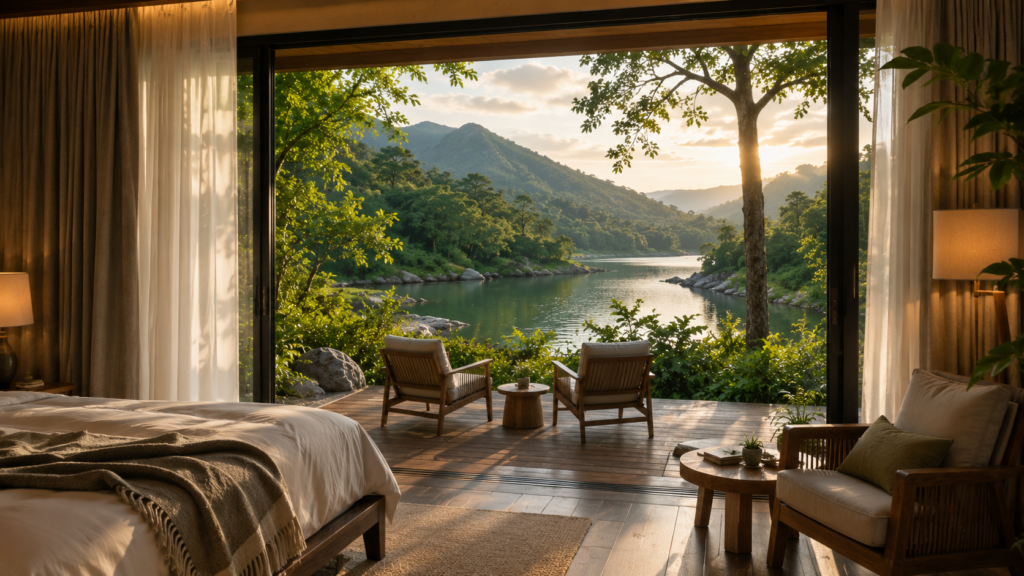
Waking up within a forest environment, or beside water, or in genuine elevation with clean air and a view that asks nothing of you is a different physiological experience from waking up in a well-appointed urban hotel room. The body registers the difference before the mind fully processes it. Heart rate, cortisol, the baseline tension in the shoulders that most people carry without noticing it. Natural environments shift all of that, and they do it passively, just by being what they are.
Serenity Wellness understood this as a founding principle. The retreat’s location in Kuruwita, Ratnapura, nestled within Sri Lanka’s forest interior, isn’t incidental to the wellness programs offered there. It’s foundational to them. The surrounding landscape, the biodiversity, the quality of air and sound and light, begins doing its work from the moment you arrive and continues throughout the stay in a way no spa menu or amenity list could replicate.
Amenities Serve the Experience. Location Creates It.
This isn’t an argument against good amenities. Thoughtful design, considered food, well-executed treatments, these things matter and they show. But they work best when the location is already doing its job, when the environment outside the property is aligned with what the stay is meant to feel like.
The question worth asking before booking isn’t only what does this hotel offer but where does it put me. What will I see, hear, and feel before I’ve made a single decision about how to spend the day? What does the air smell like in the morning? Is this a place that adds something to my state just by being in it?
A genuinely well-located hotel answers those questions before you’ve unpacked. A beautifully amenitized one in the wrong place never quite makes up the difference.
Choose the location first. The rest follows from there, and it tends to follow well.
